
Unfortunately, the majority of the discourse involving foreign investment in Canadian residential real estate is focused on the negative outcomes, high house prices, affordability issues, xenophobia, illegal activity, and the seemingly “certain” major market correction. Sensationalism and rhetoric rule the day in coverage of this topic.
The Seven Pillars Institute, an organization that explores moral issues in finance, believes affordability is at the core of foreign buyers’ discussion, concluding, “because of this, utilitarianism is the most useful lense to examine the ethics of this issue.”
They go on to say that “utilitarianism is concerned with output, Foreign Buyers | The Market Manuscript — Fall 2016 13 it argues we should maximize welfare for the maximum number of people.” The author also concludes “there needs to be a comprehensive understanding of all the impacts caused by foreign investment and any flow on effect that may result from this. With this understanding, we attach some sort of weighting system to compare for instance, people’s ability to buy homes against benefits to those in the construction industry.”
In summary, a detailed cost-benefit analysis must be undertaken. The problem is trying to weigh those issues appropriately. To a young renter, being able to afford a condominium is their top concern, and they would want to restrict demand in the market. To a current homeowner in their 60s, their top priority is to obtain top dollar for their home to fuel their retirement, and they theoretically would want maximum demand in the marketplace.
Now consider this: what if the homeowner in his 60s plans to sell their home to help assist their young renter child purchase a condo! A weighting system is beyond the scope of this report, but I have identified some costs and benefits from my MIT studies and a few others highlighted in other literature from outside Canada (see Figure 3).
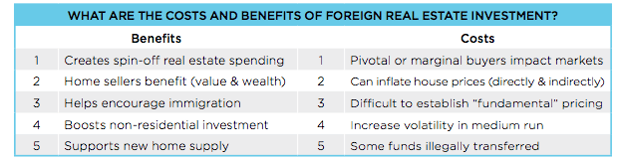
Foreign buyers often set the market price Marginal buyers are described as the buyers that would leave the market if the price were any higher.
As we know, a domestic real estate buyer will buy a home if it fits their budget, or if they think they can be cash-flow positive on the unit as an investment opportunity. As mentioned in the section above, many foreign buyers have much different motivations: to park their money, to avoid the risks involved in investments in their home country, to help establish roots for a future immigration, and other nonfinancial reasons. I acknowledge that many domestic buyers are concerned with school districts, being closer to relatives, etc.
However, I would contend that the foreign buyer’s non-financial motivations are much higher. As you can imagine the risk of losing 50% of your wealth due to a currency devaluation or major political strife is much more motivating than getting your child into the right primary school. That said, foreign buyers are often willing to pay more for the same home than a domestic purchaser, making them the marginal and very pivotal buyers. Marginal buyers tend to set prices in a marketplace.
As economic theory would tell you, prices rise faster with limited supply, and as the next section will show, there is a lack of supply in Vancouver and Toronto markets. Therefore, the marginal buyer in Vancouver and Toronto can really impact prices. Keep in mind that not all property is purchased by the highest bidder; a seller could accept a lesser offer if there was a better closing date or no conditions, both of which are less of a concern for offshore investors than domestic end-users that often have an existing home to sell.
Although we haven’t established that foreign buyers ARE driving up housing prices, if we assume they have the potential to drive up prices and consequently drive down affordability, it is worthwhile to quickly list what is being sacrificed with the loss of affordability. The report by Severn Pillars Institute had a great list, which they pulled from several sources: “affordable housing aids economic stability by preventing property market overvaluations.
Secondly, housing affordability is linked with good health, housing quality, and the welfare of children. Thirdly, individuals lessen their travel time (potentially 14 Fortress Real Developments increasing welfare through more free time) to their respective places of employment by being able to afford homes closer to their workplace. Finally, there are social benefits to be gained from the pleasure derived from a cultural attachment to home ownership.” I would definitely add higher disposable income that can be invested or consumed more productively than being locked into their home.


N5R.ai
North America's Leading HubSpot AI Agency
AI Strategy • HubSpot AI • Agent Architecture • AI Transformation
N5R.ai • WisdomClone.ai • 10X AI News • Strategic AI Coach
Ready to Become AI-First?
N5R.ai is North America's #1 HubSpot AI Agency.
Book Your Free 15-Min AI Strategy Session
It's Not The Market. It's Your AI Marketing.
www.n5r.ai · 10X AI News · WisdomClone.ai
© 2026 N5R.ai · Toronto, ON